Home

Home

Friday, May 9, 2008

Save This Building


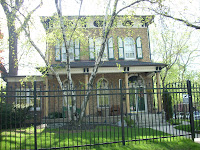
This is an exceptionally pretty 1920s-vintage courtyard located at 1422-32 W. Farwell Ave in Rogers Park. It is managed by the notorious Bil Mar management company, but until a couple of years ago, was reasonably well-maintained, and inhabited by nice people.

Information:

WCM Farwell Apt. LLC

1422-1432 W Farwell Chicago, IL 60626
Address PIN Structure ID
1422-1432 W FARWELL PIN: 11-32-116-015 01132116015000

Now, the place is looking less well, and seems to be harboring undesirable people and activities. I am getting informal reports of drug dealing in and around the building, and see a lot of unsavory-looking young men milling about the property. The maintenance has also slipped, as evidenced by extremely dry-rotted windows.

This is one of Rogers Park's huge supply of really beautiful courtyard buildings. Notice the exceptional terracotta ornamentation and tile roof. The floorplans of the apartments are standard for the era in which the building went up, with spacious, well-proportioned rooms, high ceilings, large windows, and beautiful millwork. Buildings like this are irreplaceable, and when they are deteriorated enough to need a complete gut, their beauty is completely lost when some greed-monger developer guts the place, re-arranges the original floorplan, and makes the place look like a cheap "villa" townhouse in Antioch.

Here's hoping that the ownership of this fine building decides to unload the place and free itself of the burden of properly screening tenants and maintaining the property decently, either by doing a "soft" conversion to condos (a conversion with no rehab) or co-op, or by selling to a more caring and responsible owner who operates on longer time horizons and is committed to the area.

However, there are so many government-sponsored inducements to greed and mismanagement, such as the poorly-run Section 8 voucher program in combination with minimal HUD and City of Chicago oversight of landlords who benefit from this and other socialized housing programs, that, at this time, there exist more incentives to exploit the property to the maximum advantage while giving nothing back to it, until the property is so trashed that a gut rehab and conversion (with government-guaranteed loans, of course) are the only ways to salvage it.

Thursday, May 8, 2008

Thank You Joe Moore

Many thanks to 49th Ward Alderman Joe Moore for going on record as opposing the land grab that is the proposed children's museum in Grant Park.

I urge other North Coast aldermen who are undecided to please oppose this encroachment on public land, and destruction of Grant Park. The "undecideds" include Mary Ann Smith (48th), Helen Schiller (46th), Eugene Schluter (47th) and Pat O'Connor.

Sign the petition to save Grant Park.

Thanks to Toni Duncan, at 24/7North of Howard Watchers.

Urban Agriculture in Chicago


Pictured above is a community garden located at Kenmore and Ainslie in Uptown. This garden isn't listed on Green Net Chicago's site (title link), so I don't know who operates it, but it is one of dozens of urban agricultural projects being operated in the city. Some of these have been functioning for decades, such as Resource Center's City Farm, at 1200 N. Clybourn, which can be seen from the Brown and Purple line el tracks, and which supplies upscale restaurants; and Howard Area Community Gardens, directed by Sister Cecilia Fandel, and located in the North of Howard neighborhood. This garden supplies produce to the Howard Area soup kitchen, and has 40 plots tended by area residents. These are only two of dozens of functioning community gardens and urban agricultural centers operating in the city and supplying local restaurants and farmer's markets.

Urban agricultural centers and gardens not only provide valuable agricultural training and jobs to area residents and locally grown food to area residents who make the effort to seek out their products, but will become increasingly indispensable as energy prices, and the associated costs of shipping, transportation, and arable farmland continue to escalate steeply in response to fuel prices and the diversion of land to biofuel and ethanol production.Within couple of decades, local agriculture may be the only way to feed a major percentage of Chicago's 2.9 million denizens, especially if fuel becomes scarce and expensive enough to render current farming methods, that are heavily mechanized and totally dependent upon chemical fertilizers, obsolete. Under such circumstances, much more of Chicago's thousands of vacant acres would need to be rehabilitated into farm land, which is even now probably the best use to which the vast tracts of completely uninhabited land on the city's south side could be put.

Most importantly, more citizens will gain the knowledge needed to produce food, and together contribute to a pool of knowledge that has been kept alive in front of the advance of mechanized agribusiness, only with great effort- the knowledge of agriculture, the management of land for maximum sustainability and output.

Wednesday, May 7, 2008

Pedestrian Deathtrap in Lakeview

This 6-cornered mega-pedestrian- deathtrap at the intersection of Clark, Halstead, and Barry is familiar to everyone who lives or shops in Lakeview. This intersection has been very dangerous for many years and calls to city officials have produced no results.

I timed the traffic signals here on my watch and pretty well determined that there's no way someone elderly or mobility-impaired can make it across either Clark or Halstead on the time allocated. Because you're crossing the street diagonally, the walk is longer. Most people can barely make it across on the WALK light even when trotting briskly.

Additionally, traffic on Clark turning right onto Halstead, from either direction, tends to be driving much too fast, and worse, it's easy not to notice pedestrians crossing on the green at the same time you're turning because the obtuse angle of the intersection eases you into the turn without requiring you to slow down to make the turn safely. Motorists tend to turn right without braking at all.

There are so many built-in flaws here that the only way to assure pedestrian safety is to have a WALK only signal for all directions simultaneously, as is done at Clark, Diversey, and Broadway, with simultaneous red lights that permit no turning in either direction, so that pedestrians have an opportunity to cross without encountering vehicles turning corners at top speed.

Tuesday, May 6, 2008

Why Would Anybody Live in Rogers Park?


Pictured here are a few reasons why some people like living in Rogers Park, and why we are dismayed at the elevated crime rates and continuing slumification of our neighborhood, which has evidently been designated by our local leadership as a convenient dumping ground for criminals, prostitutes, and other of the city's worst social problems.

A few people out there wonder why we Rogers Park residents who are fighting to better our neighborhood don't just move, as evidenced by the comments left on Craig Gernhart's "Broken Heart" blog recently:

"Craig: "Bitching and moaning" is the normal way Rogers Park residents communicate with each other and the outside (through their rant-ridden blogs) world. As for Commander Caluris, he may have listened patiently to all the complaints, but, as I've written many times before, he (and fellow police)secretly think you're all nuts for living in this area of the city and thinking that things will someday change.
And..

"when I first moved to Rogers Park a number of years ago, I was introduced to a local cop. He promptly asked me: "Why in the hell would you want to live here? You know the bad guys are constantly out to get you and your belongings, right?"

And...

"That's my point. Get real about the police having to be "professional" to your face, and what they're really thinking about you and where you're living.
Both RP apartments I lived in--east side near lake and west side near Western Ave.--were broken into."

Well, for starters, I can answer that once upon a time, some people wondered why anyone would live in Old Town. I can recall visiting that area in 1968 as a teen, and it made present-day Rogers Park look pristine compared.

Wicker Park was a dangerous slum in the 80s, and still has elevated crime rates, in addition to used tire yards; vacant, trash-filled lots; and ugly, crumbling housing stock that costs more than better stuff in Lakeview- another nabe remembered as dangerous and deteriorating in the 70s and before.

Why, indeed, would anyone want a reasonably priced, spacious and beautiful old house, condominium or rental in a neighborhood replete with a great beach, 24-hour public transportation and numerous other public and commercial amenities, as well as densely populated with mature trees, and that contains an incredible inventory of truly beautiful architecture and fine vintage housing of all types? Why would we not rather just move back to Lakeview and pay steeply elevated rents for housing that is unfit for human habitation and is the size of a walk-in closet; or just move over to the stodgy precincts of Jefferson Park or Portage Park, or for that matter, out to the land of crackerbox cul-de-sacs complete with 40-mile-per-direction commutes?

Maybe I'm baffled because Rogers Park compares so favorably in terms of appearance, architecture, and urban amenities, to certain trendy areas that have experienced popularity that seems inexplicable when you consider that these areas are almost all post-industrial slums replete with ugly, substandard housing, abandoned industrial buildings, and vacant lots. I had to go over Chicago Ave. not long ago, and spotted a home at Leavitt & Chicago belonging to a friend of a friend- a fugly, tiny little story-and-a-half box built a century ago as worker housing, that is now worth over $400K. This is just one more area that was, for many years, considered a total loss, and for the life of me, I can't figure why anybody would want to go there for anything at all- there's not a shard of decent architecture for a mile around, and I can't figure how they'll ever deal with all the Superfund cleanup sites and industrial slag and ruins left behind by departed industries. However, if this woman ever needs the police, I hope they respond promptly even though I think that entire area is one big post-industrial brown lot.

What disturbs me the most about the comments I've quoted, aside from the incredible myopia they reveal, is the attitude toward the citizens of this area: the idea that some populations of harmless people are simply not worthy of protection- that our leaders and law enforcement feel free to write off tax-paying, law-abiding citizens because they live in a particular area, or belong to a subset of the population that most people, for whatever reason, don't respect. This attitude seems to be pretty widespread across the country, and is probably the major reason that the United States is the most violent and crime-plagued of all Western nations. Crime flourishes in pockets of neglect and permissiveness, and certain parts of Rogers Park seem to have become unofficial "no enforcement" zones that are pretty much the property of the neighborhood lowlifes and criminals.

It also bothers me that we can so disregard a neighborhood where, recently, many thousands of people have committed hundreds of thousands of dollars each to developing or purchasing homes and condominiums, and that most of all contains so much that is beautiful, and irreplaceable.Moreover, this is still mostly a middle class neighborhood, and many residents have lived here and owned property for decades, and they've been relentlessly resisting the onslaught of blight and crime that has been visited on the area since the 1970s. These people buy and renovate houses and buildings, and pour their lives into improving their property and the area. We probably have more citizen participation in improvement efforts than any other north side neighborhood.

Most of the world's great cities took over a thousand years to build, and structures that date back that far are still cherished and cared for, yet Americans have built some of the most spectacular cities and most beautiful neighborhoods in the world, just to trash them in less than 75 years for tract houses built of pressboard and glue, which they will then discard in less than 30 years. We think that Rogers Park, and the city of Chicago, ought to last a little longer than that, especially since this country seems to have reached some kind of a limit in how much land we can cover with pavement and junk tract houses, how many miles we can commute each day, and how much money we really have to replace houses, neighborhoods, and cities as fast as we can tear them up.

Lakeview Mystery

This building in the 2800 block of N. Clark is one of Lakeview's unsolved mysteries.

Like, why have the upper three stories of apartments and/or commercial spaces not been occupied in at least 20 years? Ever since I arrived in Chicago in 1987, I've wondered why these spaces in this great-looking building have not been utilized, and I was really amazed that they weren't renovated and offered for sale or rent during the real estate craze of 2001-2006.

A friend of mine, who has owned a couple of businesses close by for many years, says that she has never been able to discover why, and neither can anyone else she knows.

Does anybody know?

Slum at 1733-35 W Pratt


A friend of mine who was trolling for another apartment tripped over this place, at 1733-1735 W. Pratt, and duly reported it to me. She told me that the hallways smelled of garbage, urine, and strange chemicals, and that there was dirt and disarray everywhere.

Note the bullet hole in the door glass in the lower right photo. Seems like many of the recent problems on Pratt close to Clark could be originating here.

A closer look shows that this building has been allowed to deteriorate steeply since last I looked, and I spotted a number of unsavory-looking individuals on and about the premises. Additionally, the beautiful 3-flats neighboring the place, which used to be pristine, have also taken a lot of damage, and are now shabby and dirty.

I searched for this property on the Cook County Assessor's site, using various search criteria from the street address to search by neighborhood, and could find nothing, so any ideas about what I'm missing on the search would be appreciated.